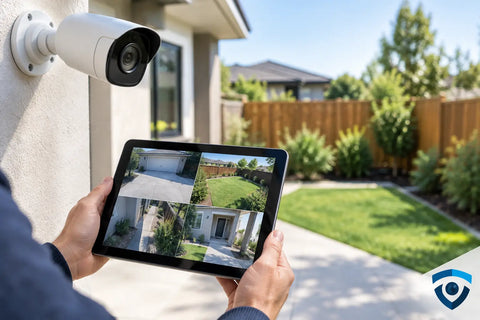
A camera mounted high on a building can look impressive and still miss the moment that matters most. A visitor may approach beneath its viewing angle, a delivery may disappear behind a parked vehicle, or an employee entrance may sit just outside the frame. Security camera blindspots are rarely caused by bad equipment alone. More often, they come from placing the right camera in the wrong location or asking one camera to cover too much.
For homeowners, property managers, and business operators, the goal is not simply to add more cameras. It is to create intentional coverage that captures usable evidence at the points where people, vehicles, and assets move.
What Creates Security Camera Blindspots?
A blindspot is any area where a camera cannot provide a clear, useful view. That can mean a complete gap in coverage, but it can also mean footage that is too dark, too distant, too distorted, or too obstructed to identify a person or event.
Field of view is the most common issue. Wide-angle cameras cover a larger area, but people and license plates appear smaller as they move farther from the lens. A camera that sees an entire parking lot may be excellent for noticing activity, yet not detailed enough to identify the person who opened a vehicle door at the far edge of the property.
Mounting height matters just as much. Cameras installed too high often capture hats, hoods, and the tops of heads rather than faces. Installed too low, they can be vulnerable to tampering or blocked by landscaping, shelving, vehicles, and foot traffic. The best height depends on the camera type, its lens, and what must be recognized in that specific zone.
Environmental conditions also change coverage. A tree that is harmless in winter can block a camera by summer. Bright sunlight can create glare at a storefront entrance. Headlights can wash out a driveway view at night. In warehouses, stacked inventory and moving equipment can turn clear sight lines into temporary blindspots throughout the day.
Start With Movement, Not Camera Locations
The strongest surveillance designs begin with a walkthrough of how people and vehicles actually use a property. Instead of starting with, “Where should cameras go?” start with, “What paths need to be documented?”
At a home, that may include the front walk, driveway, side gate, backyard access, package drop-off area, and doors that are not used every day. A side door or basement entrance is easy to overlook because it is not the primary entry, but it may offer the least visible route onto the property.
At a business, map customer entrances, employee entrances, registers, stockrooms, receiving doors, hallways, parking areas, dumpsters, and loading zones. Restaurants should consider service entrances, outdoor dining areas, and point-of-sale locations. Retail stores need clear views of entrances, aisles, cash wrap areas, and high-value merchandise. Warehouses benefit from coverage of dock doors, staging areas, fenced perimeters, and areas where inventory changes hands.
This approach separates general awareness from identification. A wide overview camera can establish where an event began and where someone went. A second, more focused camera at an entry point can capture a face, a package label, or a vehicle plate. Both views are valuable, but they serve different purposes.
Watch the transitions
Blindspots frequently occur at transitions: the point where a driveway meets the street, where a sidewalk reaches an entrance, where a hallway turns, or where a loading dock opens into a warehouse. These are areas where a person can enter or leave a scene quickly.
Corners deserve special attention. A single camera aimed down one side of a building cannot see around the corner. Two cameras with overlapping views can. That overlap is not wasted coverage. It provides continuity when a person moves from one zone to the next and reduces the chance that an obstruction blocks the only available view.
Match the Camera to the Job
There is no single camera style that solves every coverage challenge. A well-designed system combines camera types and lens selections based on the scene.
A fixed wide-angle camera is useful for broad areas such as patios, lobbies, open offices, and general parking coverage. A narrower field of view can be better for an entrance, gate, driveway, or cash-handling point where facial detail matters. A varifocal camera allows the installer to adjust the viewing angle during deployment, making it a practical choice when the final framing needs to be tailored to the site.
Pan-tilt-zoom cameras can follow activity and cover large outdoor spaces, but they come with an important trade-off: while the camera is turned in one direction, it is not watching another. They work best as a supplement to fixed cameras, not a replacement for them. Fixed cameras preserve continuous coverage of critical doors and pathways.
Night performance should be evaluated in the actual environment, not only from a specification sheet. Infrared illumination can be effective in complete darkness, but reflective surfaces, glass, white walls, and nearby objects may cause glare or overexposure. Exterior lighting often improves both image quality and property usability. In some cases, a properly placed light is the simplest way to reduce a nighttime blindspot.
Check Sight Lines in Real Conditions
A camera view should be tested when the property is active. Review footage in daylight, at night, during rain if possible, and while normal traffic is present. A view that looks clear from a ladder may be blocked when a delivery truck pulls in or when employees park in their usual spaces.
For residential installations, test the view with a person walking toward and away from each entrance. Check whether faces remain visible under a porch overhang, near a bright window, or at the edge of the driveway. If license plate capture is a priority, test it at the vehicle speeds and distances that apply to the property. A general driveway camera is not automatically a license plate camera.
For commercial properties, assess activity during opening, closing, deliveries, and peak operating hours. The camera that clearly sees an empty aisle at 7 a.m. may lose its view when displays, carts, or customers fill the space. A loading dock should be tested with trailers in place, not just when the dock is empty.
Do not let glass create false confidence
A camera aimed through a window may appear to cover an exterior area, but nighttime reflection usually makes the footage unreliable. Infrared light can bounce off the glass, turning the image into a reflection of the room rather than a view outside. When exterior coverage matters, an exterior-rated camera positioned outside the glass is usually the better solution.
Design for Overlap, Storage, and Network Reliability
Closing physical gaps is only part of the job. Footage is not useful if it cannot be recorded, retrieved, or trusted.
Critical areas should have purposeful overlap from another camera whenever practical. For example, an entrance camera can capture a face while a wider camera documents the route to and from that door. In a retail setting, an overview camera can show activity around a register while a focused camera provides a closer view of the transaction area.
Storage should match the risks of the site. Higher-resolution cameras, more cameras, longer retention periods, and continuous recording all require more capacity. Motion-based recording can conserve storage in quiet areas, while continuous recording may make more sense at a busy entry, register, dock, or perimeter. The right approach depends on operations, retention needs, and how quickly an incident may be discovered.
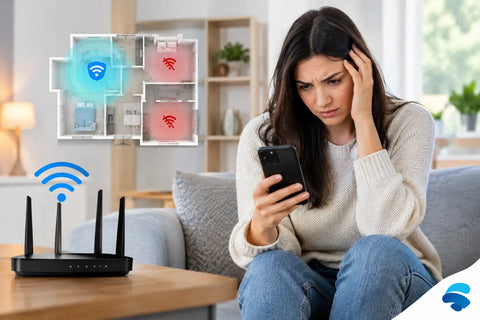
The network also deserves attention. Cameras rely on stable switching, appropriate cabling, power delivery, and secure remote access. A weak WiFi connection may be acceptable for a low-priority indoor camera, but hardwired connections are generally the better choice for critical cameras and larger systems. Professional low-voltage planning keeps cables protected, equipment organized, and performance consistent as the system grows.
When a Professional Site Assessment Makes Sense
A small home may only need a few carefully placed cameras. A multi-entrance building, restaurant, warehouse, or retail location usually benefits from a formal coverage plan. The more complex the property, the easier it is to create gaps by adding cameras one at a time without considering the full layout.
A site assessment can identify viewing angles, lighting concerns, cable pathways, network capacity, mounting surfaces, and future expansion needs before equipment is installed. It also helps avoid common compromises, such as placing a camera where wiring is easiest rather than where coverage is most effective.
Wall Street Networks designs surveillance systems around the way each property operates, connecting camera placement with the network, power, access points, and infrastructure behind it. That integrated approach is especially valuable when a project includes access control, WiFi upgrades, outdoor coverage, or a new build with low-voltage wiring still accessible.
The best next step is simple: walk your property from the perspective of someone trying to avoid being seen. Every unobserved path, obstructed corner, and poorly lit transition is a place worth reviewing before it becomes the reason footage falls short.